The quick version
- Snowshoeing for beginners takes no prior experience. Most people walk normally within a few minutes of putting the frames on.
- A snowshoe spreads your weight over a much larger area than a boot, so you stay on top of snow that would otherwise swallow your leg.
- Hiking poles come with the snowshoes and help with balance on uneven ground, especially in the first stretch before you settle in.
- The guide fits your snowshoes, adjusts your poles, and shows you the wider stance before the group sets off across Kvaloya.
Getting Fitted Before You Set Off
Before anyone takes a step, the guide matches a pair of snowshoes to your boots and sets your poles to your height. Snowshoes and poles are both included in the booking, so there is no separate kit to source and nothing to bring beyond your own footwear. The whole process happens standing still, in the open air on Kvaloya, and takes only a couple of minutes for each walker.
A thermal suit and boots are available on request and subject to availability. It is worth asking for them early rather than assuming they will be there, since the operator cannot guarantee stock on every date. If you already have warm, waterproof layers and sturdy boots of your own, the snowshoes and poles are the only equipment the day actually depends on.
How a Snowshoe Actually Works
The idea behind a snowshoe is simple and it is worth understanding properly, because it explains almost everything about how the first hour feels. A boot sole concentrates your whole body weight onto a small patch of snow, which is why an ordinary boot punches straight through anything beyond a thin crust. A snowshoe spreads that same weight across a much larger surface, so the snow underneath has to support far less pressure per square inch.
That difference is why you stay on top of snow that would otherwise take you in past the knee. It is not a trick and it does not depend on skill: it is a straightforward matter of surface area, and it works the same way for a first-timer as it does for the guide. Once you feel it under your own feet, the rest of the hour is mostly about getting used to the shape of the frame rather than learning a new technique.
Walking in Them Is Not Difficult
Walking in snowshoes is not difficult, but it does feel odd for the first few minutes. The frames are wider and longer than a boot alone, so your normal stride has to open up slightly to stop one snowshoe clipping the other as you swing your leg through. The guide points this out early, and most people correct it without thinking about it again after the first few strides.
The wider stance also changes how you place your feet on uneven ground. You end up walking a little more deliberately than you would on a pavement, lifting each foot a touch higher and setting it down flatter. None of this requires strength or balance beyond an ordinary walk. It simply takes a short adjustment period, and that period is measured in minutes, not in the length of the outing.
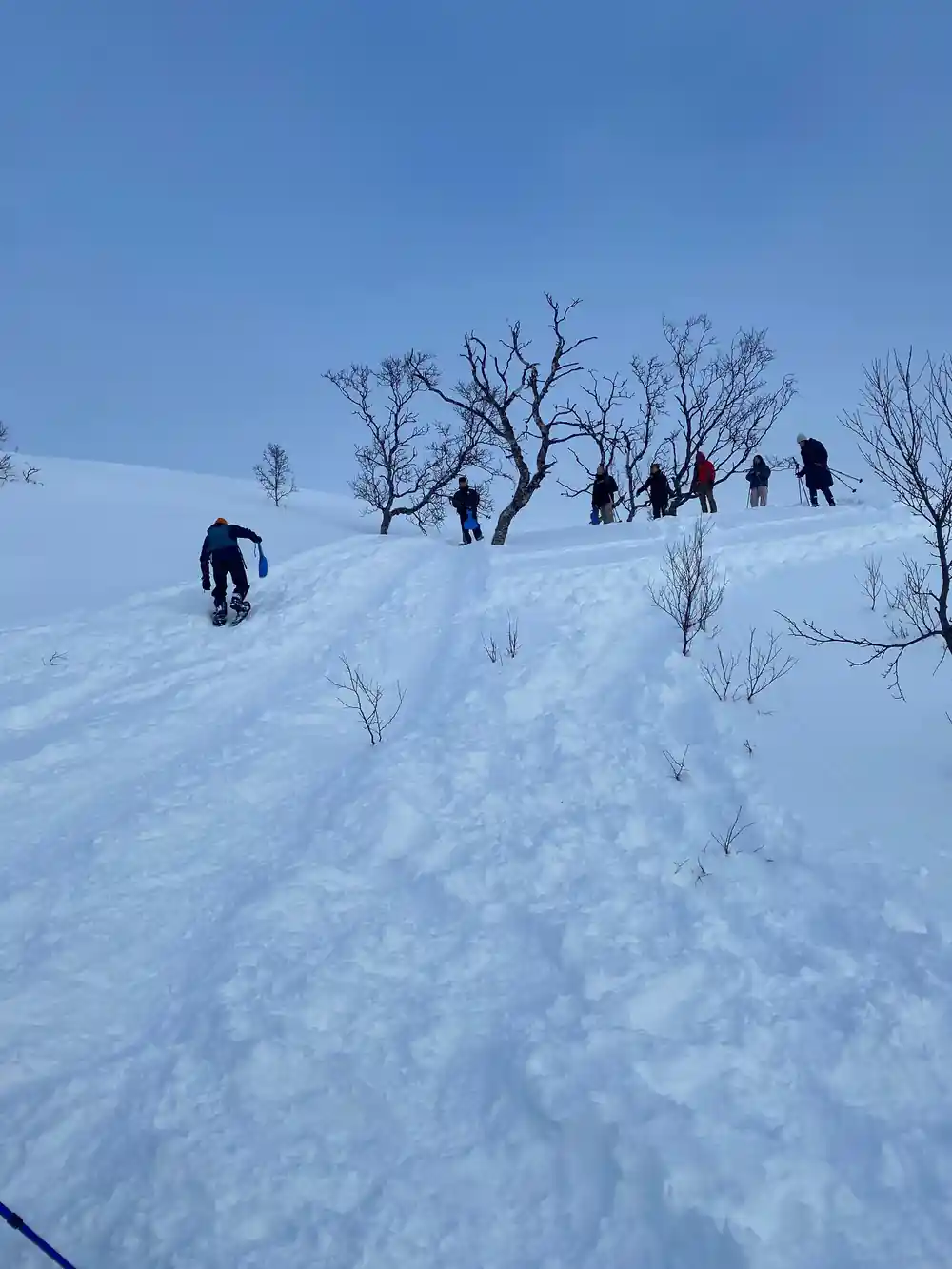
Snowshoes and poles laid out on Kvaloya before the group sets off
How Long It Takes to Get Used to Them
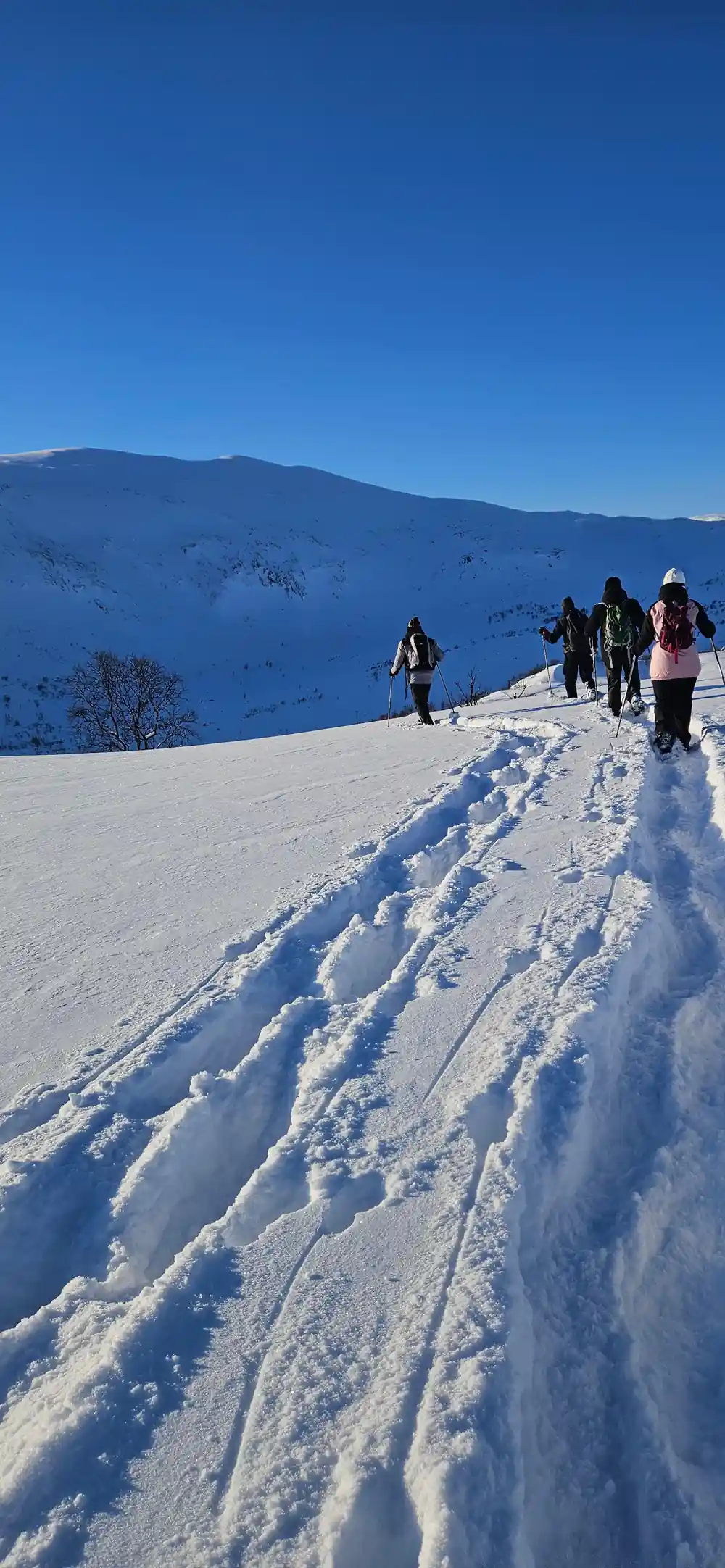
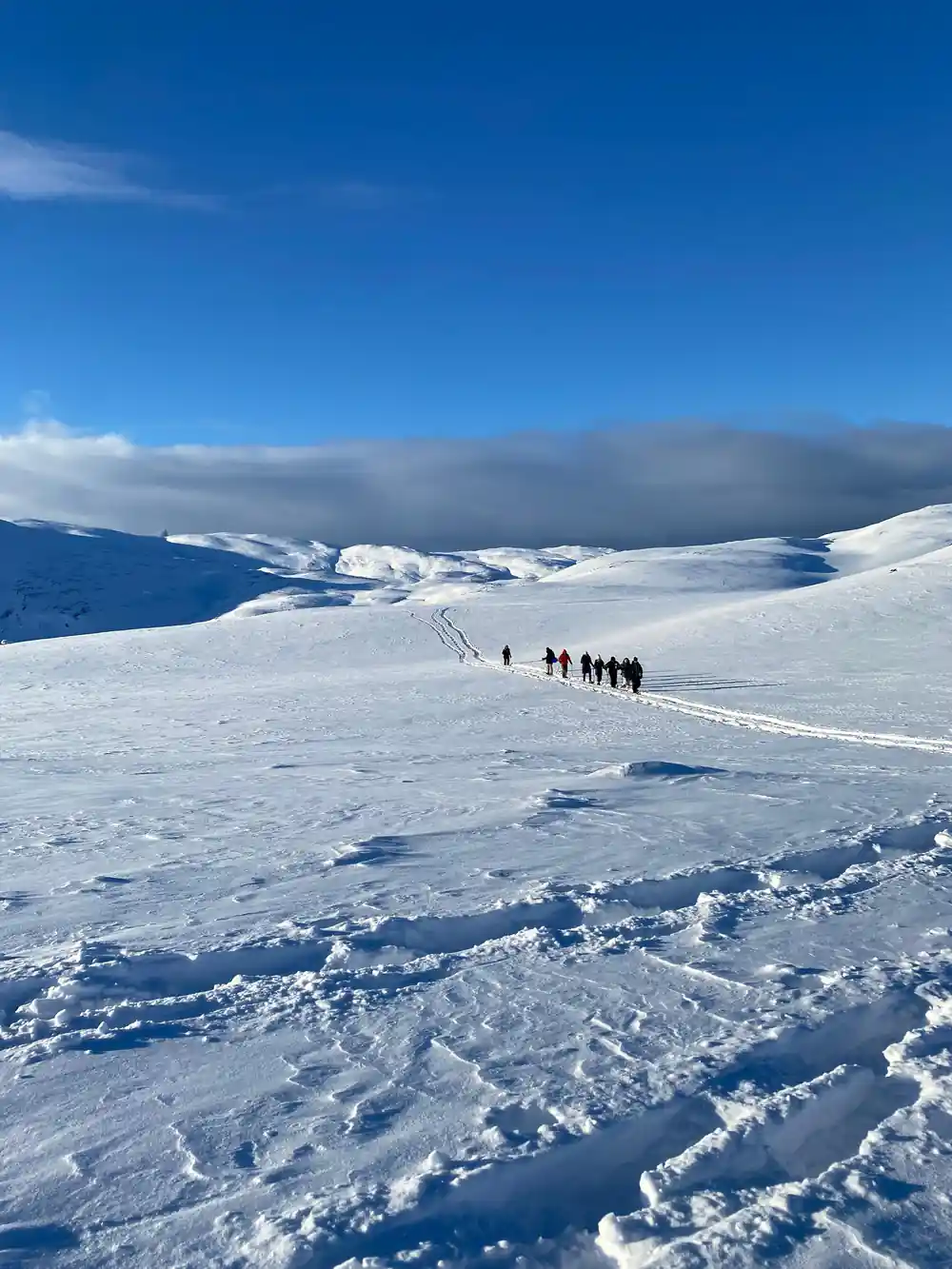
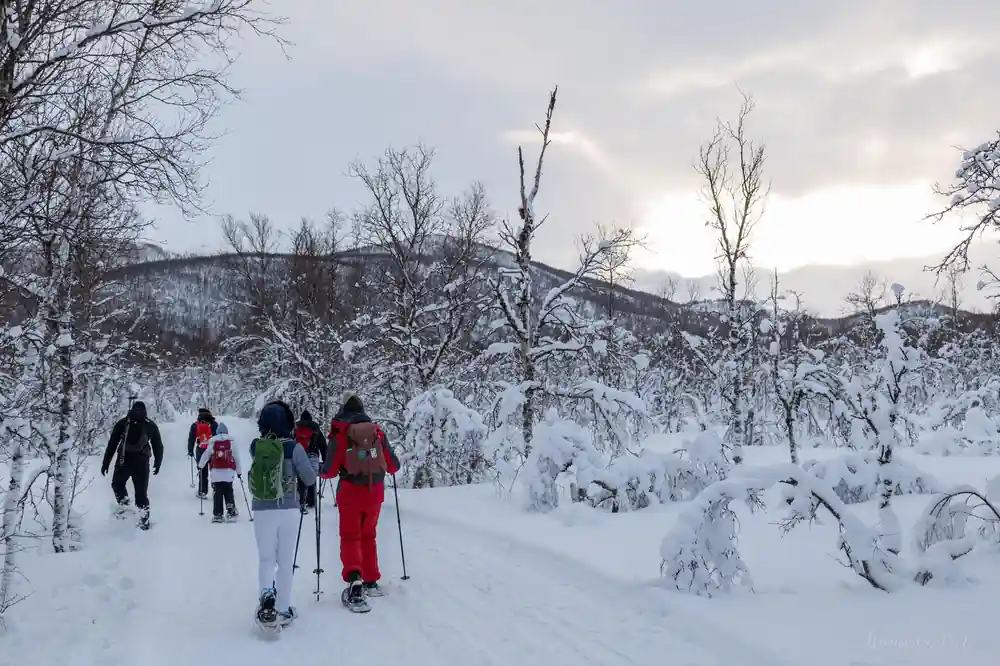
Almost nobody needs instruction beyond the first few minutes. The guide talks the group through fitting, stance and pole use once, at the start, and after that the walking itself does the teaching: you feel what works and what does not within the first dozen steps. By the time the group has crossed open ground on Kvaloya for a few minutes, most people have stopped thinking about their feet altogether.
Overselling how hard this is would be its own kind of dishonesty. Snowshoeing for beginners is designed around exactly this: equipment that does the work of keeping you on the surface, and a short, guided adjustment period rather than a skill that takes practice to build. The picnic lunch partway through the day is as much a natural pause as a reward, and by then the frames barely register.
Poles, Balance and What Happens If You Fall
Hiking poles are included alongside the snowshoes, and most people use them the whole time rather than only when the ground is uneven. They give you two extra points of contact with the snow, which matters most in the first minutes before your legs have adjusted to the wider stance, and again on any softer or lumpier patches later in the walk.
Falling over in snowshoes is common among first-timers and it is rarely more than a soft, slow topple, since the wide frames tend to catch you rather than let a foot slide away entirely. Getting back up is the slightly awkward part: you plant both poles, roll onto your knees, and push up from there rather than trying to stand straight from a seated position. The guide is on hand to help anyone who gets properly stuck.
What the Guide Actually Does
The guide's job in that first hour is mostly quiet supervision rather than formal teaching. They fit the equipment, demonstrate the stance once, and then walk near the back or middle of the group watching how everyone is coping rather than lecturing as you go. If someone is struggling with a pole grip or a loose strap, they step in and fix it on the move.
Beyond the equipment, the guide sets the pace across Kvaloya so that the group stays together and nobody is left working harder than they need to. They also hand round the picnic lunch, biscuits and hot drinks included in the booking partway through, and they are the one who knows the ground well enough to pick a sensible line across it. None of that requires the walker to have done anything like this before.
Ready to try snowshoeing for beginners on Kvaloya
from US$148Reserve now & pay later
Your questions, answered
Do you need any experience to go snowshoeing?
How do snowshoes actually work?
Is it hard to walk in snowshoes?
How long does it take to get used to them?
Do you need hiking poles for snowshoeing?
What happens if you fall over in snowshoes?
What does the guide actually do on the walk?
Is snowshoeing good for a first Kvaloya visit?
Your First Few Minutes
Getting fitted with snowshoes and poles
The guide matches snowshoe size to your boots and sets each pole to your height. This happens before anyone starts walking.
Standing up on the frames
The snowshoes feel wide and unfamiliar underfoot at first. Most people plant their poles, push up slowly, and find their balance within seconds.
The first few steps
Early steps are short and a little stiff. You lift each foot slightly higher than normal, since the frame is wider and longer than a boot alone.
Finding the wider stance
Snowshoes work best with feet set a little further apart than usual, so the frames do not catch each other. It becomes automatic quickly.
Moving off with the group
Within a few minutes most people are walking at a normal pace, and the guide checks in with anyone still adjusting before moving on.